
The Golden-Haired, Bare-Skinned Alien of 1897
At the height of America's Mystery Airship craze, a respected traveling salesman claimed that he encountered the occupants of a strange flying machine in the Missouri countryside. His fantastic story reads like a UFO encounter from the 1950s... except it happened in 1897.
By Kevin J. Guhl
On a sunny Friday in April 1897, W. H. Hopkins wandered through the hills a few miles east of Springfield, Missouri, and came upon something that should not have been there.
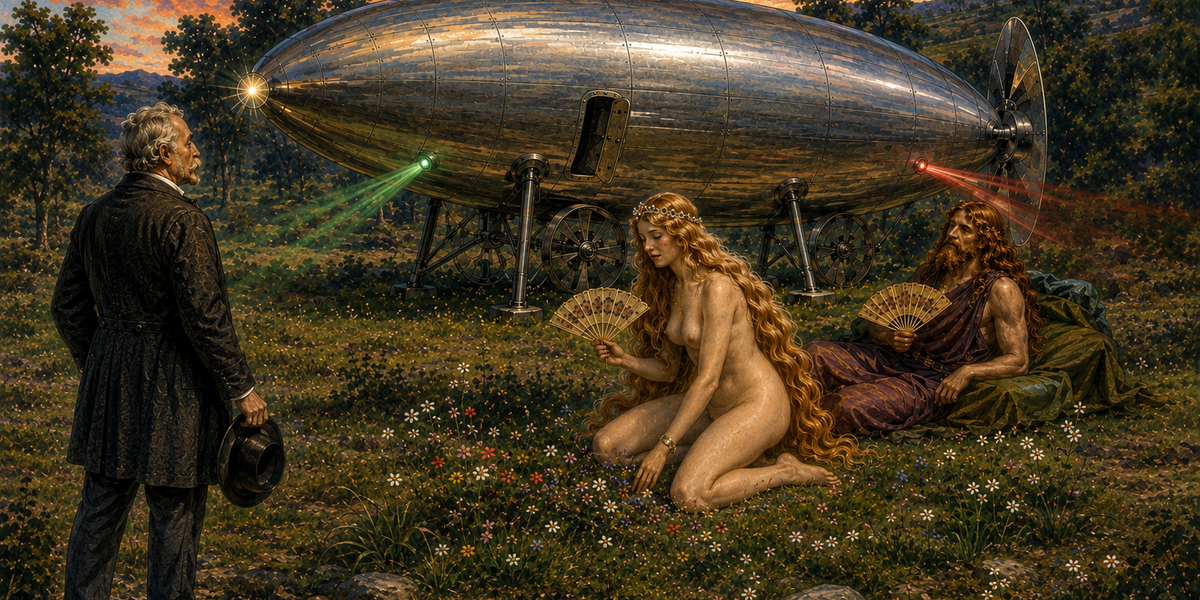
Below him, in a small clearing, rested a metallic vessel about 20 feet long. Sunlight gleamed from its surface like it was polished aluminum. The strange craft stood upon four supports, with two propeller-like wheels positioned beneath it and another at its stern.
But it was not the airship that astonished Hopkins most.
Near the vessel, a petite young woman was picking spring flowers.
Hopkins would describe her as the most beautiful being he had ever seen. She wore no clothing. Golden hair fell in waves to her waist, held from her face by a band of glittering jewels. She carried a curious fan and delighted in the flowers she gathered, laughing and speaking in a language Hopkins could not understand.
Nearby, in the shadow of the strange machine, rested her companion: a powerfully built man with shoulder-length auburn hair and a beard falling to his chest.
For a moment, Hopkins wondered whether he had stumbled upon a new Adam and Eve.
Then the woman saw him... and screamed.
Within minutes, the startling encounter became something even stranger. Hopkins shook hands with the man, kissed the woman's hand, inspected their fantastic vessel and attempted, through gestures, to ask the pair where they had come from.
They looked upward.
They pointed toward the sky.
And they spoke a word that, to Hopkins' ears, sounded like:
"Mars."
If W. H. Hopkins was telling the truth, one of the strangest encounters in the history of unidentified flying objects occurred more than half a century before anyone had ever heard of a "flying saucer."
But even if he wasn't, there is something remarkable about his story.
Because W. H. Hopkins was real. His employer was real. The St. Louis Post-Dispatch investigated him and interviewed his family. And when his extraordinary account appeared on April 19, 1897, the skies over America's Midwest were already in an uproar...
MYSTERY AIRSHIPS OVER THE MIDWEST
America was looking upward in 1896 and 1897. Hopkins' Close Encounter of the Third Kind was not a standalone event but part of the "Mystery Airship" wave that swept the U.S. during that time, fueled by public anticipation that powered flight would be soon be a reality. In fact, most sightings of mystery airships were presumed to be the testing of new aircraft by secretive inventors. Extraterrestrial encounters were more of an outlier in these cases, although the entire phenomenon mirrored the flying saucer craze that would begin in the 1940s. In fact, the St. Louis area itself was beset with various mystery airships during the spring of 1897.
"It is general belief that an air ship is floating over the States of Missouri, Illinois, Iowa and Kansas. This belief is entertained by men of scientific attainments as well as those not so well versed in the field of natural philosophy," wrote the St. Louis Post-Dispatch on April 10. Some locals laughed at the report of a strange aerial body that had been seen over those states the previous two weeks, suggesting witnesses were fooled by optical illusions "due to excessive libations" or by a brilliant star magnified into an aircraft by their imaginations. But the evidence that something unusual was moving amidst the clouds became so conclusive and corroborated during the previous three days "that wiseacres have ceased to jibe," wrote the Post-Dispatch. The newspaper concluded that "clearly there is something unusual in the air. And it has not only substance but form."
Correspondents in all four states telegraphed details about a luminous object seen moving in a northwesterly direction on the night of April 9, 1897, flashing different colored lights. Though most people primarily observed a great headlight, many claimed to have seen the object in more detail. "The general description is this: A long steel body, shaped like a cigar, 50 feet long and 6 to 10 feet in diameter, with wing-like attachments on the sides, while fore and aft appear wheel-like connections similar to the steering apparatus of a steamship. The top is capped by a balloon-like bag, though oblong, and seemingly attached to the cigar-shaped vessel by ropes, as the upper part has been observed to sway violently." Thousands in Chicago witnessed the craft. Professors at Washington and St. Louis universities trained their telescopes on the night sky to try and solve this mystery sweeping the Central West. The most prevalent hypothesis was that some inventor who had cracked the problem of aerial navigation was operating in secret. Alternately, wrote the Post-Dispatch, "These may be visitors from Mars, fearful, at the last, of invading the planet they have been seeking."
Reports came in of the airship traveling over St. Louis and Chillicothe, Missouri on the night of April 10, although a "mystic bluish white light" was all that was visible. But the airship returned with a vengeance two nights later. Thousands of St. Louisans watched a powerful searchlight strobe back and forth across the sky. Many witnessed, behind it, the shadowy form of a craft that either resembled a whaleback or a cigar. The airship had three signal lights—one white, one red and one green—in conformance with maritime law.
Thousands of witnesses reportedly spotted the bright searchlight over St. Louis on the night of April 15. Dr. Leo Caplan, a throat, eye and ear specialist, trained his home telescope on the object and discerned a long, black, cigar-shaped body behind the light. Thomas B. Fluke, on the other hand, "saw stars" while looking for the airship on the morning of April 13, after he fell off his roof, fracturing a rib and spraining his ankle.
THE HOPKINS LETTER
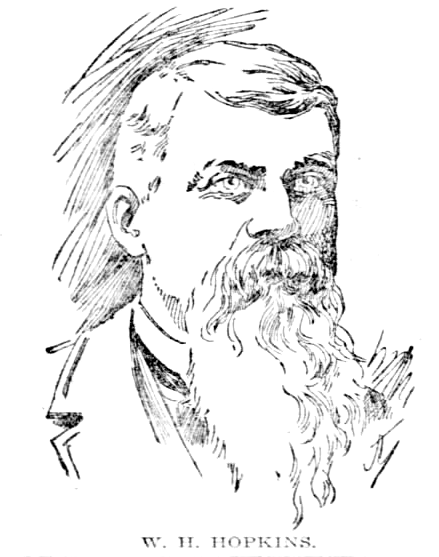
"In the mass of evidence which has reached the Post-Dispatch concerning the existence of an airship that is said to be floating over the Central West, the most astonishing is that furnished by Mr. W. H. Hopkins, general traveling agent for the Hartford Steam Boiler Inspection and Insurance Company," the Post-Dispatch wrote on April 19. The newspaper published a full letter from Hopkins (reproduced below) on the center of its front page, detailing his close encounter in the hills of southwest Missouri. The incident occurred Friday, April 16, 1897, which happens to be just one day before the infamous (and alleged) Aurora, Texas UFO crash. Hopkins wrote:
To the Editor of the Post-Dispatch:
Till yesterday I had supposed the numerous reports of the appearance of a mysterious airship in the different parts of the country (in many instances widely separated) at nearly the same hour, were but the result of very vivid imaginations.
I thought the first report of an airship was started by some Munchausen of the press to gratify some mischievous whim and to see how many imaginative people would fall in line and claim—honestly of course—that they had seen it also. My impression was strengthened by my own experience a few days ago, when in Kansas City a friend and myself thought we saw a bright light in the heavens, which frequently disappeared and then reappeared again, but which we afterwards found was the evening star, which was intensely bright, but which was occasionally obscured by light clouds of steam, which were not visible to us in the darkness.
But after my adventure of yesterday my doubts of the reality of the air ship have been dispelled. I was wandering through hills east of Springfield, Mo., and coming to the brow of a hill overlooking a small clearing in the valley a short distance below me I saw a sight that rooted me to the spot with amazement for some time. I could not believe my eyes at first, and shook myself to see if I was not dreaming. There in the clearing rested a vessel similar in outline to the air ship shown in the Post-Dispatch of a few days ago, and said to have been taken in Illinois.
As the sun shone upon it the rays were reflected as from burnished aluminum. It rested upon four legs or supports, which raised it from the ground sufficiently to give room for two wheels like the propeller of a ship lying horizontally; one at the bow and one near the stern. Another at the stern lying perpendicularly was evidently for the purpose of propelling the vessel ahead, while the other two raised the vessel. The vessel itself was about twenty feet long and eight feet in diameter and the propellers about six feet in diameter.
Near the vessel was the most beautiful being I ever beheld. She was rather under medium size, but of the most exquisite form and features such as would put to shame the forms as sculptured by the ancient Greeks. She was dressed in nature's garb and her golden hair, wavy and glossy, hung to her waist, unconfined excepting by a band of glistening jewels that bound it back from her forehead. The jewels threw out rays of light as she moved her head. She was plucking the little flowers that were just blossoming from the sod, with exclamations of delight and in a language I could not understand. Her voice was like low, silvery bells and her laughter rang out like their chimes. In one hand she carried a fan of curious design that she fanned herself vigorously with, though to me the air was not warm and I wore an overcoat.
In the shade of the vessel lay a man of noble proportions and majestic countenance. His hair of dark auburn fell to his shoulders in wavy masses and his full beard of the same color, but lighter in shade, reached to his breast. He also was fanning himself with a curious fan as if the heat oppressed him.
As I looked with astonishment on the picture, I wondered if Adam and Eve had come to earth again, or was I dreaming?
After gazing for a while I moved forward, and the woman, hearing the rustle of leaves, looked around. A moment she stood looking at me with wonder and astonishment in her beautiful blue eyes, then, with a shriek of fear, she rushed to the man, who sprung to his feet, threw his arm around her and glared at me in a threatening manner.
I stopped and, taking my handkerchief from my pocket, waved it in the air. A few minutes we stood. I then spoke some words of apology for intruding, but he seemed not to understand, and replied in a threatening tone and words which I could not make out. I tried by signs to make him understand, and finally he left her, trembling and trying to hold him back, and came toward me. I extended my hand. He looked at it a moment, astonishment depicted in his dark-brown eyes, and finally he extended his own and touched mine. I took his and carried it to my lips. I tried by signs to make them understand I meant no harm. Finally his face lighted up with pleasure, and he turned and spoke to the woman. She came hesitatingly forward, her form undulating with exquisite grace. I took her hand and kissed it fervently. The color rose to her cheeks and she drew it hastily away.
I asked them by signs where they came from, but it was difficult to make them understand. Finally they seemed to do so and smiling they gazed upwards for a moment, as if looking for some particular point, and then pointed upwards, pronouncing a word which, to my imagination, sounded like Mars.
I pointed to the ship and expressed my wonder in my countenance. He took me by the hand and led me towards it. In the side was a small door. I looked in. There was a luxurious couch covered with robes of the most beautiful stuff and texture, such as I had never seen before. From the ceiling was suspended a curious ball, from which extended a strip of metal, which he struck to make it vibrate. Instantly the ball was illuminated with a soft, white light, which lit up the whole interior. It was most beautifully decorated with scenes such as I had never seen before.
At the stern was another large ball of metal, supported in a strong frame-work and connected to the shaft of the propeller at the stern was similar mechanism attached to each propeller and smaller balls attached to a point of metal that extended from each side of the vessel and from the prow. And connected to each ball was a thin strip of metal similar to the one attached to the lamp. He struck each one and when they vibrated the balls commenced to revolve with intense rapidity, and did not cease till he stopped them with a kind of brake. As they revolved intense lights, stronger than any arclight I ever saw, shone out from the points at the sides and at the prow, but they were of different colors. The one at the prow was an intense white light. On one side was green and the other red.
The two had been examining me with the greatest curiosity in the meantime. They felt of my clothing, looked at my gray hair with surprise and examined my watch with the greatest wonder. Signs are poor medium to exchange ideas and therefore we could express but little.
I pointed to the balls attached to the propellers. He gave each of the strips of metal a rap, those attached to the propellers under the vessel first. The balls began to revolve rapidly, and I felt the vessel begin to rise, and I sprang out, and none too soon, for the vessel rose as lightly as a bird, and shot away like an arrow, and in a few minutes was out of sight. The two stood laughing and waving their hands to me, she a vision of loveliness and he of manly vigor.
Probably people will ask as they did of the farmer in Iowa: "Where did you get your whisky?" But I can say if I ever drank liquor I would go immediately and get some more of the whisky.
If you wish to learn anything more particularly regarding my experience my address is 517 Security Building, St. Louis.
W. H. HOPKINS
Muskogee, I. T., April 17, 1897.
After receiving the letter, the St. Louis Post-Dispatch set out to verify the identity and character of the author, who was still out of town on business. A reporter visited 517 Security Building, the address Hopkins indicated, and found it to be the St. Louis headquarters of the Hartford Steam Boiler Inspection and Insurance Co. They showed the strange letter to the manager, C. C. Gardiner (although the article misspelled his surname as "Gardner").
"This is wonderful," Gardiner said, reading through the letter carefully. "That is Mr. Hopkins' handwriting and he is now in that territory. He was also at Springfield on the day named. He is [a] traveling agent for the company."
"Do you believe what he says?" the reporter asked.
"Indeed I do," said Gardiner. "Strange as it seems, I am compelled to believe it. Mr. Hopkins is not a romancer. He never courts notoriety. What he writes he has seen and he believes it is his duty to make the facts public. He does not drink a drop. He has been connected with this company for a long time and is most reliable. What he writes you can publish as being absolutely true."
While Mr. Gardiner was talking with the reporter, several company clerks examined the letter. They compared the writing with that of letters recently received from Hopkins, and felt it conclusively proven that the same hand had penned all of them. The clerks added their testimony regarding Hopkins' reliable character to that given by Gardiner.
Gardiner would add, with a sigh, "If he had only left the woman out of the yarn."
The reporter for the Post-Dispatch then visited Hopkins' residence at 5028 Minerva Avenue. His wife and two daughters were told of the strange letter that had been received.
"It's the truth if he wrote it," said Mrs. Hopkins, "and I believe every word."
The daughters chimed in to the same effect.
"The last letter I received from Mr. Hopkins," continued his wife, "was dated Springfield, Mo., April 15. This was apparently the day before he saw the airship. I will probably receive a letter this afternoon telling me all about it."
Mrs. Hopkins showed the reporter the earlier letter. The handwriting was identical with that of the letter describing the airship.
"Would Mr. Hopkins have any reason for perpetrating a hoax? Is he given to jesting?" was asked.
"Quite the contrary. He is most serious," replied Mrs. Hopkins. What, a man 50 years of age writing such a letter without it being true! No, sir; every line of it is true. Mr. Hopkins is a member of the Maple Avenue M. E. Church, and has many friends in the West End. He undoubtedly wishes to acquaint his friends with the marvel he has seen, and so uses the Post-Dispatch as the medium of communication. Mr. Hopkins left home a week ago. Before he left, he ridiculed the idea of an airship having been seen. But now I suppose he is convinced it is not a myth. Truly, it is wonderful."
Mrs. Hopkins followed up with some shade, adding, "I was surprised Mr. Hopkins wrote the Post-Dispatch, for after the election he vowed he would never read the paper again and said it must not come into the house. But I suppose he wanted everybody to see his article."
"The letter is not a hoax," concluded the newspaper.
On the morning of April 20, both Gardiner and Mrs. Hopkins were asked for an update and said they were still awaiting further news from Hopkins. Frustratingly, it does not appear that Hopkins was ever interviewed upon his return, or an interview published. As fantastic as the golden-haired alien story is, though, the main players can at least be verified in more mundane records outside the airship story coverage. C. C. Gardiner was indeed general agent of the Hartford Steam Boiler Inspection and Insurance Co., which was located in Rooms No. 516-517 Security Building, No. 319 North Fourth Street in St. Louis. W. H. Hopkins was truly a special agent for the company, still working for them in 1899 and traveling on business.
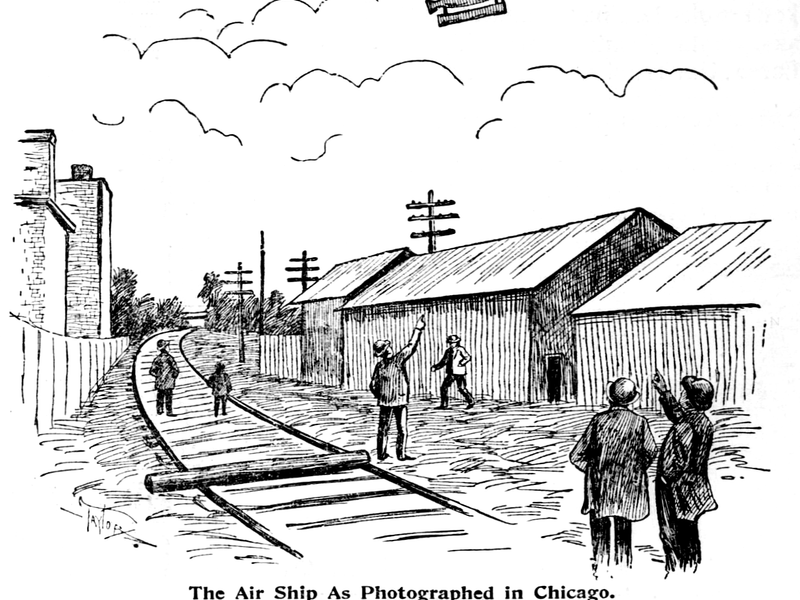
Note that Hopkins referenced the vessel he saw being similar in outline to an illustration of an airship witnessed in Illinois, published a few days earlier in the St. Louis Post-Dispatch. He was likely referring to the April 13 edition of the paper, which featured a front-page illustration, said to be drawn from a photo taken by Walter McCann, of a mystery airship spotted over Chicago. Several bystanders in the illustration stood along a railroad track, pointing at the strange vessel, shown in silhouette coasting through the air above them.
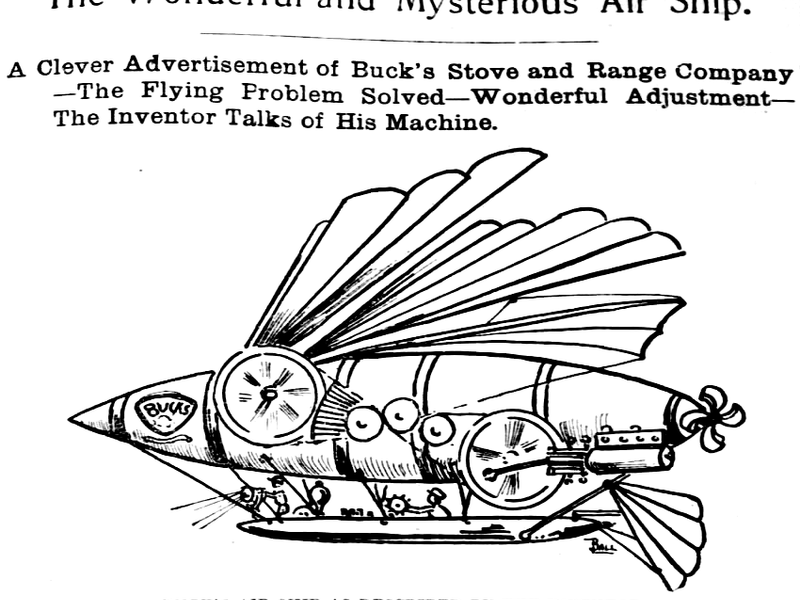
For a more detailed idea of what the airship was imagined to look like, see the below illustration. Buck's Stove & Ranges of St. Louis ran this drawing with an advertisement in the April 14 Dispatch, claiming that the entire airship craze was their own advertising scheme. The workable airship, they claimed, was actually a small, unmanned model built by their scientific superintendent, described as "a fish-shaped gas tank, with the machinery cleverly attached underneath." Of course, the Buck's trademark was emblazoned on each side of the gas chamber. The "searchlight" was achieved via ignitable cartridges filled with chlorate of potash compound. ("The discovery that the airship is shad-shaped adds to the fishiness of the airship stories," remarked the Post-Dispatch on April 26.)
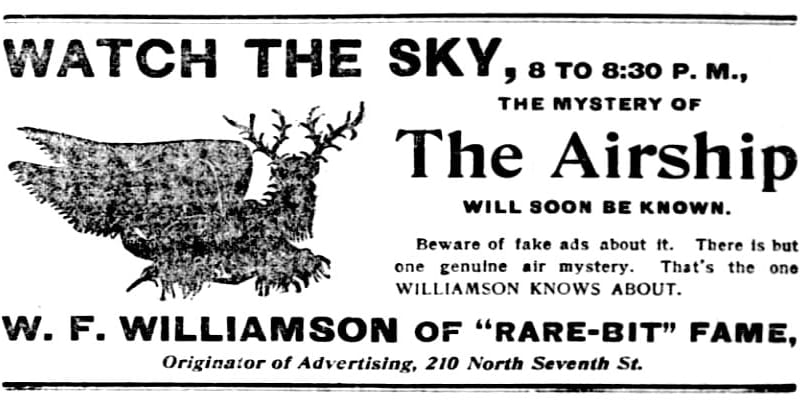
SIDEBAR: During the height of the mid-April 1897 mystery airship wave, St. Louis billboard painter W. F. Williamson brilliantly capitalized on the public's skyward anxiety to promote his advertising firm. Placing a prominent advertisement in the St. Louis Post-Dispatch, Williamson urged readers to "watch the sky" for an airship mystery that would soon be revealed, and warned the public to "beware of fake ads" about it. Instead of sketching a mechanical craft, however, Williamson illustrated the ad with the striking silhouette of the Piasa, a legendary creature (likely the "underwater panther") originally painted as a sacred indigenous pictograph on the limestone bluffs of nearby Alton, Illinois. By the 1850s, the original cliffside artwork had been completely destroyed by commercial limestone quarrying. Public perception of the Piasa (including Williamson's ad) was thereafter based on a drawing of the bird-winged beast included in local antiquarian William McAdams’s 1887 book, "Records of Ancient Races in the Mississippi Valley." Seventeenth-century French explorer Father Jacques Marquette, the first European to document the Piasa, made no mention of wings on the pair of dragon-like monsters he saw painted on the bluffs. However, McAdams collected testimony from old-timers in the area who claimed that the wings had grown faint with age and only stood out when the rocks were wet. Nevertheless, the romanticized (by McAdams' own admission) flying version of the Piasa in his book became the default image of the creature. And by substituting the region’s original, legendary "flying monster" for the modern mystery airship, Williamson cleverly utilized a shared, deeply familiar local folklore to command the attention of St. Louis consumers.
ENTER THE SKEPTICS
Reactions to Hopkins' airship encounter were mixed. "The St. Louis man who saw the airship says it has two wheels lying horizontally and one lying perpendicularly. The St. Louis man's wheels, no doubt, lie both ways," snarked the Chicago Dispatch. Meanwhile, the Marionville Free Press opined, "The eagerness to see the much talked of airship was greatly increased after Dr. Hopkins' letter appeared in which he stated he beheld and conversed with the beautiful lady occupant, who was clad only in nature's own garb. There is no wonder at this eagerness."
Despite the St. Louis Post-Dispatch concluding that Hopkins' letter, at the very least, was genuinely written by him, editor Charles H. Jones revealed his true feelings on the matter in response to a concerned letter writer on April 23. Lee Clinton, a resident of Tulsa, Oklahoma (then Indian Territory), asked, "The people of this part of the Indian Territory are anxious to know if there is any truth in the airship story? What is your honest opinion? Do you believe Mr. Hopkins' story written from Muscogee. I. T.?" Jones replied, "The Post-Dispatch does not believe there is an airship in existence at present. The unusual brilliancy of Venus, the 'evening star,' has doubtless been the basis for several of the airship stories. Others are mere yarns."
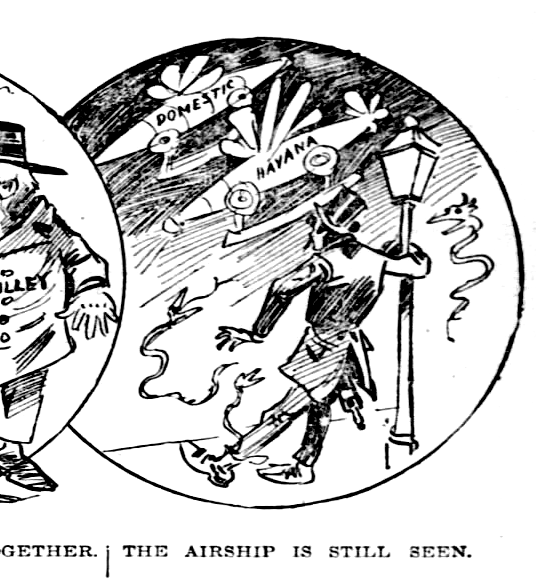
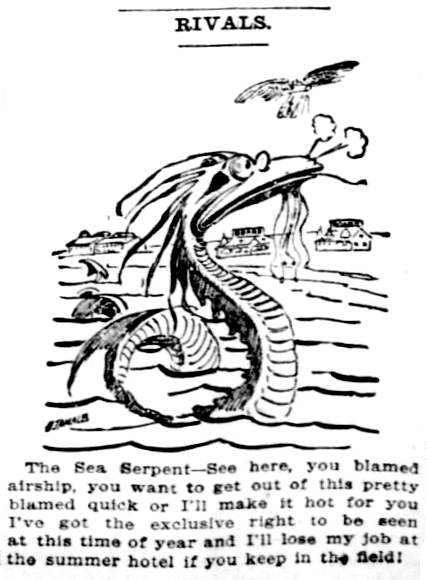
Overall, some skeptical readers of the Post-Dispatch blamed Venus and Mercury, brilliant during twilight on the Western horizon, for the city's airship sightings that spring. Of course, that didn't stop the phenomenon. George W. Lubke, Jr., a well-known attorney in St. Louis, claimed to have seen an airship in broad daylight at 5:45 p.m. on May 7, 1897. It moved slowly over the city, at one point stopping and turning slowly about above Thomas Street. This gave Lubke an opportunity to view it more closely. The airship was not exactly cigar-shaped, as the deflections at the end were shaped like the stern of a canoe. There was a white object in the center of the craft's side, although Lubke couldn't determine whether it was a painted wheel or a canvas. The airship then traveled rapidly toward the northwest, disappearing over the city fairgrounds.
SHAPED LIKE A DRAGONFLY
Interestingly, Hopkins' story coincides with another airship tale, nearly as weird, said to have occurred in the Springfield area the previous night. It was reported by the Springfield Republican on April 16, the day of Hopkins' supposed encounter just outside town. Per the Republican:
The airship is a veritable fact. It has been seen by responsible people of Springfield and has possibly caused an action against the Memphis Railroad company.
Last night near Cabool, as related by Judge [J. A.] Frink, who was a passenger on the train, No. 4, in charge of Engineer Charley George, was brought to a stop so suddenly as to wake up all of the sleeping passengers and alarm the nervous ones. The Judge did not belong to either class, but when the train stopped he went out on the platform and instead of walking into the light of the pale moon which was then shining brightly, he stepped into what seemed to be the shadow of a cloud.
On looking up he saw that the object which obscured his view was an airship and as the lights were brilliant thereon he was able to give a good description, taking the comparative size from the train. The model adopted for the ship seems to have been the dragon fly. There are two sets of wings— the superior ones are about twice as wide and six times as long as a passenger coach, the inferior ones being about half the size and extending in the rear as do the wings of the dragon fly.
The main body of the craft is about the size of a passenger coach or slightly above, of about the same proportions, though it is not as deep. It is cigar shaped in form but as in the dragon fly it has long, narrow extension to the rear, in which the lighting and motive apparatus seems to be stored. On either side of the extended "tail" are wings which like the main ones, seem to be made of wire covered with strong silk, but the rear ones have no motion save to be depressed or raised as the ship rises or falls in the air. As near as can be judged aluminum is the material employed in the construction of the vessel and from the apparent thickness it seems to have been made in the form of hollow plates which may be filled with hydrogen gas. There was no "balloon" in the popular sense of the word, apparent to those who saw the machine, but the large canvass cover to the vessel which swayed in the light breeze then stirring may have been filled with a gravitation resisting gas. Electricity is undoubtedly the motive power, as wires run from what seemed to be the dynamo room to every part of the vessel, and it is certainly lighted by that power. The designer when he fitted it up for his present mysterious trip evidently intended to scare the nervous and superstitious, and to amaze the general public. Two search lights are set upon the front and are capable of being turned in all directions, and the glass through which they shine can easily be changed from clear to green, red and blue by an instantaneous process. Besides these two search lights a row of lamps extend along either side of the deck, composed of incandescent globes of various colors and the "tail" is susceptible of complete illumination, when it shines like something phosphorescent. Aside from this the captain, who appeared for an instant on the vessel's deck as it left the train, has one of the latest improved fluoroscopes with some peculiar inventions of his own which enables him to operate it in the open air. With this he has no difficulty in penetrating the dark places of the earth, seeing through the roofs of the houses as easily as through their windows.
Comparatively little noise is made by the machine in traveling, but a crackling sound as that produced by a trolley car on a rainy day was heard as it passed. When at rest there was no noise save that of the wind fanned by the large wings which swayed gently, keeping the craft afloat. All of this description takes time to read, but it was seen in a few moments.
The cause of the train stopping was found to be a horse which got upon the track in a mysterious manner and lost its life under the wheels. The carcass was removed and the train sped on toward Springfield. The track was clear before the machine passed over it and it is supposed that the horse either fell or was thrown from the airship upon the track.
The airship was seen afterwards in Springfield. Those who saw it seem to think it has political significance.
...However, the Republican promptly undermined its own reporting with satire by quoting additional airship witnesses in Springfield who claimed that they had met the captain and learned the crew were out duck hunting, were unhappy with the results of the recent municipal election in the city's Fourth Ward, and wanted to know the council's decision on slot machines.
AIRSHIP ANIMAL
There was even a strange sequel to Hopkins' UFO encounter in Springfield, published in Missouri papers in late April. Apparently, the airship had a habit of ejecting livestock!:
SPRINGFIELD'S FIND.
A Strange Animal Supposed to Have Come from the Airship.
Jim Smith, of the Springfield fire department, is now a firm believer in the airship and he has on exhibition at the fire department today an animal which he says proves conclusively that the airship has visited Springfield. Some time during last night, says the Springfield Leader-Democrat, the thing was found on the city lot in the rear of the fire barn and the members of the department are sure that the airship swooped down there and left the beast in order to lighten the load. Hundreds of people have visited the department today to see the strange visitor and all are agreed that it is not a native of this planet. Jim Smith had no doubt that it came from Mars. The animal more nearly resembles a mule than anything else, though all who have seen it agree that it is not a mule. It is 2½ feet high with legs scarcely larger than a man's finger and very long and crooked. There is wavy brown hair on the visitor's back nearly a foot long, very much like that of an Angora goat. His ears are the most prominent part about him, and in this he seems to be related to the mule, but under his chin are long whiskers like those usually worn by a billy goat. His feet are a sight to behold, and nothing like them were ever seen before. They are much like those of a mule, except twice as long and much smaller, tapering to a very sharp point in front, as though designed for mountain climbing. His eyes were evidently not made for the earth, for he cannot see in daytime, and winks and blinks as though the sunlight gave him great pain. The boys at the fire department have been unable to find anything he would eat as yet, and he turns up his nose at hay, oats, corn and bran as though supremely disgusted. It is evident, however, that he is not a wild beast for he seems to enjoy being fondled by human hands. His long and shaggy hair leads to the belief that he came from a very cold climate. The boys at the fire department will give a very liberal award for the animal's pedigree. Public opinion is divided as to whether he is a member of the mule family or belongs to the goat species.
VISITORS FROM MARS
We might laugh today at aliens visiting us from Mars, which we've now seen to be a barren wasteland. But back in the late 19th century, people still pondered if there might be intelligent life on our planetary neighbor. It was certainly on Hopkins' mind. To be fair, though, he stated that when the aliens pointed upward and identified their home planet as Mars, that was only his interpretation of a language he couldn't understand. Could it be coincidental that Hopkins' Martian story appeared in April 1897, the very same month that the first installment of H. G. Wells' "The War of the Worlds" debuted in serialized form in the pages of both Pearson's Magazine (in the U.K.) and Cosmopolitan (in the U.S.)? On May 2, the St. Louis Post-Dispatch even promoted Wells' story in the Cosmopolitan as "an airship story that promises to eclipse all others"!
Also, while the dark-eyed "grey" alien is standard in today's concept of extraterrestrials, there was a greater variety of species reported during the early days of the UFO phenomenon. Hopkins' beings are somewhat reminiscent of the Nordics, a beautiful and benevolent race said to hail from the Pleiades star cluster. Nordic aliens were said to look very much like tall human beings with long and straight blonde hair, blue eyes and fair skin.
Hopkins described the vessel he encountered as having "wheels" or propellers, as one might expect on his day's concept of an airship. But the craft was otherwise stunningly similar to mid-20th century UFO reports, with a metallic hull, support legs, futuristic controls, brightly colored lights, and incredible airspeed. Although Hopkins compared the vessel to the illustration of the Chicago airship, he didn't mention it having a balloon, which is curious. Despite taking place during the 1896-97 Mystery Airship Wave, Hopkins' account could fit almost seamlessly into 1950's UFO lore.
Whatever happened in the hills outside Springfield, Missouri that April afternoon in 1897, the greatest mystery may be W. H. Hopkins himself. He was no anonymous correspondent hiding behind a fantastic tale. His identity, employment and travels checked out, while the people who knew him best insisted that he was a sober, serious man who neither courted publicity nor had a reputation for telling tall tales. Yet Hopkins left behind a story so extraordinary that even his own employer wished he had "left the woman out of the yarn." Perhaps Hopkins was simply swept up in the great airship mania of 1897, adding his own imaginative contribution to a phenomenon already hovering somewhere between observation, rumor, satire and folklore. Or perhaps something happened to him that he could only describe in the technological language available to a man of the Victorian Age. More than a hundred years on, there is probably no way to know. All that remains is Hopkins' remarkable account of a metallic vessel resting in a Missouri clearing, a beautiful golden-haired woman gathering spring flowers beside it, and two strangers who smiled, pointed toward the heavens and spoke a word that sounded like "Mars."
SOURCES:
"Golden Haired Girl Is In It." St. Louis Post-Dispatch, 19 Apr. 1897, pp. 1-2.
"Mystery Airship." Wikipedia, https://en.wikipedia.org/wiki/Mystery_airship. Accessed 31 Aug. 2026.
"Airship in the Heavens." St. Louis Post-Dispatch, 10 Apr. 1897, pp. 1-2.
"What Light Do We See?" St. Louis Post-Dispatch, 11 Apr. 1897, p. 4.
"Aerial Wonder Seen in St. Louis." St. Louis Post-Dispatch, 12 Apr. 1897, pp. 1-2.
"Air Ship Seen." St. Louis Post-Dispatch, 13 Apr. 1897, pp. 1-2.
"Saw Stars Instead of Airship." St. Louis Post-Dispatch, 14 Apr. 1897, p. 9.
"Airship Viewed by Telescope." St. Louis Post-Dispatch, 16 Apr. 1897, pp. 1-2.
"Aurora, Texas, UFO incident." Wikipedia, https://en.wikipedia.org/wiki/Aurora,_Texas,_UFO_incident. Accessed 31 Aug. 2026.
"Still Believes In Him." St. Louis Post-Dispatch, 20 Apr. 1897, p. 6.
St. Louis Republic, 26 Mar. 1894, p. 8.
"Insurance Gossip." St. Louis Globe-Democrat, 3 Jun. 1899, p. 16.
"Made in St. Louis." St. Louis Post-Dispatch, 14 Apr. 1897, p. 6.
St. Louis Post-Dispatch, 26 Apr. 1897, p. 4.
"Watch the Sky." St. Louis Post-Dispatch, 17 Apr. 1897, p. 2.
"W. F. Williamson Signs." St. Louis Post-Dispatch, 26 Sep. 1897, p. 21.
"Piasa Bird." Mythic Mississippi Project, https://mythicmississippi.illinois.edu/native-illinois/piasa-bird/. Accessed 31 Aug. 2026.
McAdams, William. Records of Ancient Races in the Mississippi Valley. St. Louis, C. R. Barns Publishing Co., 1887.
"Piasa." Wikipedia, https://en.wikipedia.org/wiki/Piasa. Accessed 31 Aug. 2026.
"With the Exchanges." St. Joseph Daily News [St. Joseph, MO], 28 Apr. 1897, p. 4.
Marionville Free Press [Marionville, MO], 29 Apr. 1897, p. 4.
"Letters from the People." St. Louis Post-Dispatch, 23 Apr. 1897, p. 4.
"Letters from the People." St. Louis Post-Dispatch, 16 Apr. 1897, p. 4.
"Letters from the People." St. Louis Post-Dispatch, 20 Apr. 1897, p. 4.
"An Airship Seen in Open Daylight." St. Louis Post-Dispatch, 8 May 1897, p. 1.
"That Great Air Ship." Springfield Republican [Springfield, MO], 16 Apr. 1897, p. 2.
"Springfield's Find." Republican-Courier [Jefferson City, MO], 30 Apr. 1897, p. 5.
"Is It Mule or Goat?" Carthage Press [Carthage, MO], 29 Apr. 1897, p. 8.
Gangnes, Madeline B. "The Novel." The (De)collected War of the Worlds, 22 Jan. 2025, https://decollected.net/novel/. Accessed 31 Aug. 2026.
"Literary Notes." St. Louis Post-Dispatch, 2 May 1897, Sunday Magazine p. 12.
Wells, H. G. "The War of the Worlds." Cosmopolitan, vol. 22, no. 6, Apr. 1897, pp. 615-627.
"Nordic Aliens." Wikipedia, https://en.wikipedia.org/wiki/Nordic_aliens. Accessed 1 Sep. 2026.
"Flying Saucer." Wikipedia, https://en.wikipedia.org/wiki/Flying_saucer. Accessed 1 Sep. 2026.
Written by
Kevin J. Guhl
Journalist and researcher investigating forgotten American history, cryptids, folklore, and the paranormal. Author of American Strangeness.