The Main Street Ghost: Tucson's Shape-Shifting Monster
What stalked Tucson's Main Street after dark in 1894? Was it a ghost, a shape-shifting witch, a phantom beast, or something altogether more earthly?
By Kevin J. Guhl / American Strangeness
In September 1894, panic swept Tucson's Main Street. Residents claimed that something prowled the city after dark, a creature whose appearance seemed to change from night to night. Some swore it was a gigantic black dog with blazing eyes. Others insisted it resembled a burro, a hog, or even a man crawling on all fours. Armed posses hunted it. Newspapers chronicled it. A suspected witch was blamed. And before the mystery was over, the "Main Street Ghost" would become one of the strangest episodes in Arizona history and folklore.
On Sep. 23, 1894, Tucson's Arizona Daily Star wrote, "Whether it is a new brand of fire water or something from the front parlor of Hades that is causing all the commotion in the neighborhood about Carrillo's Gardens is a question deep, gruesome and as yet unanswered. That something decidedly unconventional has been tramping down that way for several nights is quite certain. But what the something is remains up to date unknown." Residents along Tucson's Main Street were scared out of their wits, certain that "an unearthly object is meandering about during the black night in their neighborhood."
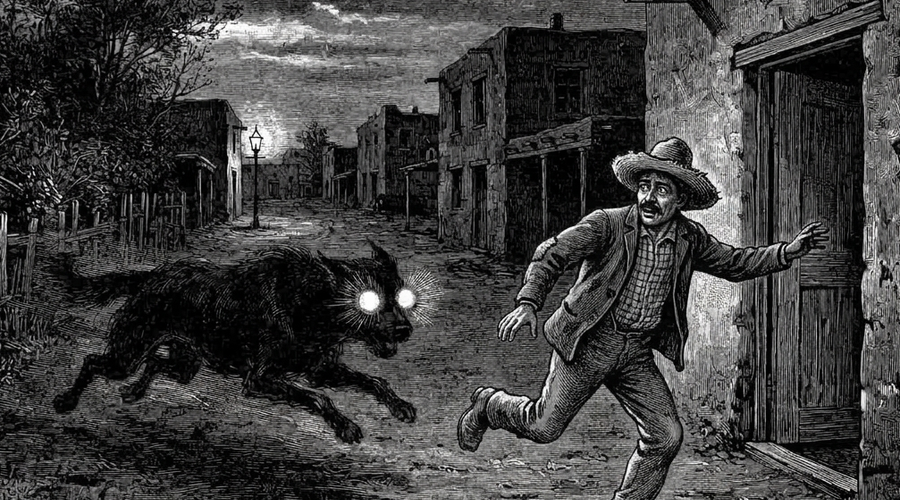
On the night of Sep. 19, a Mexican resident of the town's southern outskirts was walking leisurely homeward after visiting friends on North Meyer Street. At about 11 p.m. he was on Main Street opposite Carrillo's Gardens when a "peculiar" animal rushed out at him. He kicked defensively at the threatening beast and hit nothing but "climate," wrote the Daily Star. The man then saw that the animal was sitting quietly 20 feet away from him. He resumed walking, only for the creature to dart forward and fade from sight. His fear growing, the man ran about 10 feet, only to catch another glimpse of the strange beast. It seemed to be toying with... or hunting... him. The pedestrian dashed toward home in a mad panic, the animal staying hot on his heels. Finally, the man reached his house and barged through the door into safety. He had difficulty describing the animal afterward, other than it being quadruped and its eyes looking "like great balls of fire."
What lent credence to the unnerved witness' story was the fact that more than 20 other people, "some of them men to whom fear is a thing unknown," had similar eerie experiences in the Main Street area. But few could agree on what exactly the "something" was, as its appearance seemed to change each night. "One night it looks like a dog; on another it resembles a small-sized burro, with eyes little smaller than the search lights of a modern man-of-war; and then it appears as a human being moving about on hands and knees," reported the Daily Star.
Barrio Libre: A City Within a City
To understand these strange events in 1894 Tucson, it's helpful to step back in time and examine the city's social structure as it stood at that point in history. Founded as a Spanish military fort in 1775, Tucson had evolved into a Mexican community by the time the United States acquired the territory in the Gadsden Purchase of 1853. Tucson grew into the Arizona Territory's most populous city and served as its capital from 1867 to 1877. The city's growth brought an influx of Anglo settlers, although they remained a minority until the early 1900s.
Some of the Mexican inhabitants prospered during the city's expansion and guided it. But the marginalized lower class of Tucson's Mexican community were displaced as the new Anglo arrivals began acquiring land and asserting their influence. By the early 1880s, the less affluent Mexican residents were congregating directly south of Tucson's business district, forming a community that became known as Barrio Libre (meaning free or liberated neighborhood). Barrio Libre encompassed about a quarter of the city during the late 19th century, lying along Meyer and adjacent streets, with Main Street as its western border. (Tucson's early business district was concentrated between Broadway and Alameda, Main and Church Streets.) With its labyrinthine lanes and alleys, and adobe homes with spacious interior courtyards, Barrio Libre was noted during this era as looking like "a bit of old Mexico transplanted to the Northern Republic."
Barrio Libre's population was a mix of Sonoran Mexicans and their Native American neighbors, the Papago (today called Tohono O'odham) and Yaqui. Tensions existed between the less affluent Mexican-American population and Anglos, partly due to different customs and partly because some Spanish-only speakers lost their land as the result of English-written tax laws they didn't understand. There was also a religious divide, with the majority of the Mexican-Americans being Catholic and most of the Anglos being Protestant. Therefore, per a 1972 University of Arizona report on Barrio Libre, it became convenient for the groups to reside in segregated communities, the latter "within their presidio walls."
An 1881 Tucson City Directory described Barrio Libre as once having been lawless, residents sleeping on the street "in peaceful intoxication" while others indulged in amusements such as "Fandangoes, monte, chicken fights, broils," and that many of these activities still prevailed. But, the directory pointed out, "It must be understood that these remarks apply only to the lower class of Mexicans and not to the cultured Mexican residents of the city, who, for intelligence and enterprise, are foremost among our people." Examining this period in 2010, Lydia R. Otero wrote that Anglos repeatedly generalized Barrio Libre as a place where Mexican-Americans fled to avoid law enforcement and freely engage in decadence, vice and corruption. However, Otero reframes Barrio Libre "as a multicultural place where Mexican Americans, Tohono O'odham, and Yaqui joined in each other's collective celebrations."
Armed Posses and Suspected Witches
On the Friday night, Sep. 22, several residents of Tucson's south side armed themselves with pistols, knives and clubs, and set out "to make short work of the disturber of the wonted peace and quiet of Main street." When the vigilance committee reached the allegedly haunted locality, the unearthly animal appeared before them, rising up as if from out of the ground. Instantly, several shots rang out, and the animal lunged at the posse. One man slashed at the creature's body as it passed under him, but struck nothing save air. Confronted with this unearthly horror, the terrified townspeople fled the scene.
Suspicions turned, as they have often done throughout history amongst the superstitious, toward witchcraft. "There is an old woman down that way, whose hair long ago turned to gray. She lives alone in a miserable dilapidated adobe, and is given a wide berth by the suspicious ones, who regard her as an agent for the inhabitants of another world," wrote the Daily Star. "Since the appearance of the Main street ghost, many of the Mexicans have come to the conclusion that the peculiar something is sent out by this old woman, who they claim has power to make dogs, burros and everything else do her bidding. In the last two days she has been scratched considerably about the face, and as she refuses to disclose how she received the scratches, the superstitious Mexicans are all the more positive that she is a witch." The Daily Star would clarify in a later article that the supposed witch was "a harmless old woman," perhaps in a thoughtful moment of belated caution.
A competing Tucson newspaper, the Arizona Daily Citizen, stated that the woman was Papago, a Native American people of the Sonoran Desert. "The story goes that a Papago woman is possessed of an evil spirit, which leaves her body every night and meanders through the city, sometimes in the shape of a dog, cat, hog, cow, horse, man or woman," wrote the Citizen. "A number of visionary things have been shot at and it is the opinion of the 'well informed' that if the spook can be killed with a silver bullet the old Papago woman will be found dead in her hut. In the meantime there is a good deal of praying done in the haunted vicinity, and nightly efforts are being made to compel the old lady to turn up her toes to the daisies."
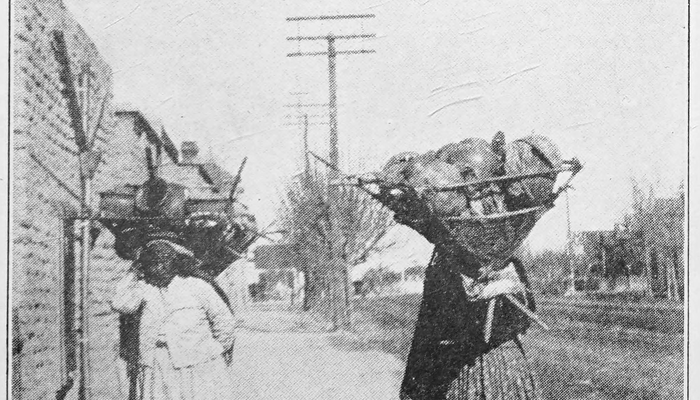
A competing explanation for the ferocious apparition was that it was the spirit of a Mexican thief who was shot dead some years prior while "in the act of stealing a rooster and three fat hens from a Main Street coop." His body was buried near Carrillo's Gardens, not far from the spot where he died. A rude, weather-beaten cross had marked his last resting place until shortly before the events of this story.
Carrillo's Gardens: The Scene of the Haunting
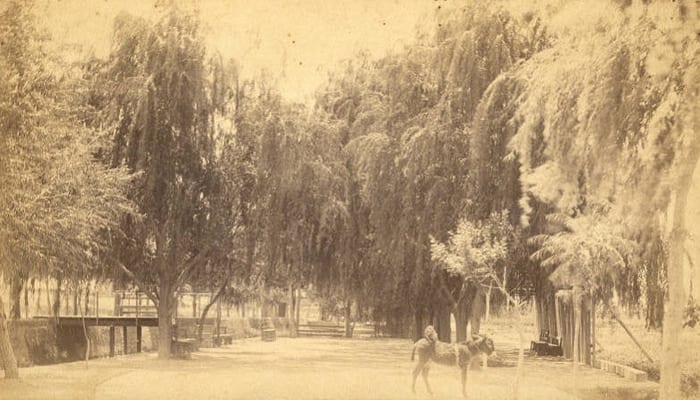
Carrillo's Gardens, the scene of the haunting, was located to the west of Main Street, on which many of Tucson's prominent families kept their homes. The gardens were installed by Leopoldo Carrillo, who in 1870 was Tucson's wealthiest entrepreneur. He was born in Moctezuma, Sonora in 1836, arrived in Tucson in 1859, and a decade later was one of the most prominent businessmen in town, a member of the Mexican elite. Carrillo did more than anyone else, Mexican or Anglo, to develop Tucson during the 1870s and 1880s.
Carrillo built and owned more than 100 houses in the city, making him one of Tucson's largest landlords. He also erected a combined hall/saloon/ice cream parlor and a bowling alley (the first on the Arizona frontier). His additional ventures included long-distance freighting, ranching and farming. Carrillo had a keen interest in gardening, raising quality peaches and grapes, and implemented this passion during the mid-1880s by opening Carrillo's Gardens as an oasis-like park for city residents. Per writer Thomas E. Sheridan, this was Tucson's "crowning glory" in the late 19th century. Fed by local springs, Carrillo's Gardens featured eight acres with fruit trees, rose gardens, man-made lakes, a luxurious saloon, private rooms, hot baths and a dance pavilion. The city's elite hosted parties there and the public enjoyed boating, picnicking, weekend concerts and the extended celebrations of Fiesta de San Agustin to Mexican Independence Day from late August through mid-September. Carrillo's Gardens was the center of social life in Tucson during the late 1880s and 1890s, although Carrillo himself died in 1890.
"More than a hundred Mexicans were running up and down south Main street on Monday night trying to capture the ghost," the Daily Star wrote on Sep. 26. "There is beyond a doubt something quite unconventional in the south end of town that is causing all of this intense excitement, but what it is no one is able to say. The superstitious claim that it is a ghost; others shake their heads, denying the existence of spirits on earth, but are unable to account for the strange phenomenon."
Tales of further "gruesome and sensational" brushes with the entity, now known as the Main Street Ghost, continued to emerge in the Daily Star's continued coverage over the next few days. (YouTube channel Dime Store Adventures, where I first learned of this tale, dubbed it "The Main Street Phenom.") A man riding his horse in the "haunted locality" around Carrillo's Gardens was thrown to the ground with a thud when the phantom, in the shape of a hog, spooked the steed. The hog gave a loud squeal, then vanished. A police officer, Billy Roche, reportedly emptied his gun at the hideous monster. Another Mexican resident claimed that he caught "the something" by the horns shortly after midnight and saw stars for half an hour afterward. In one incident, the phantom, in the shape of a dog, stole three chickens but dropped the plunder when shot at and disappeared.
The Arizona Citizen was unimpressed. "With a properly colored glass, enough of it, the south Main street spook can be seen any dark night," it chided.
The Nagual: A Shape-Shifting Tradition
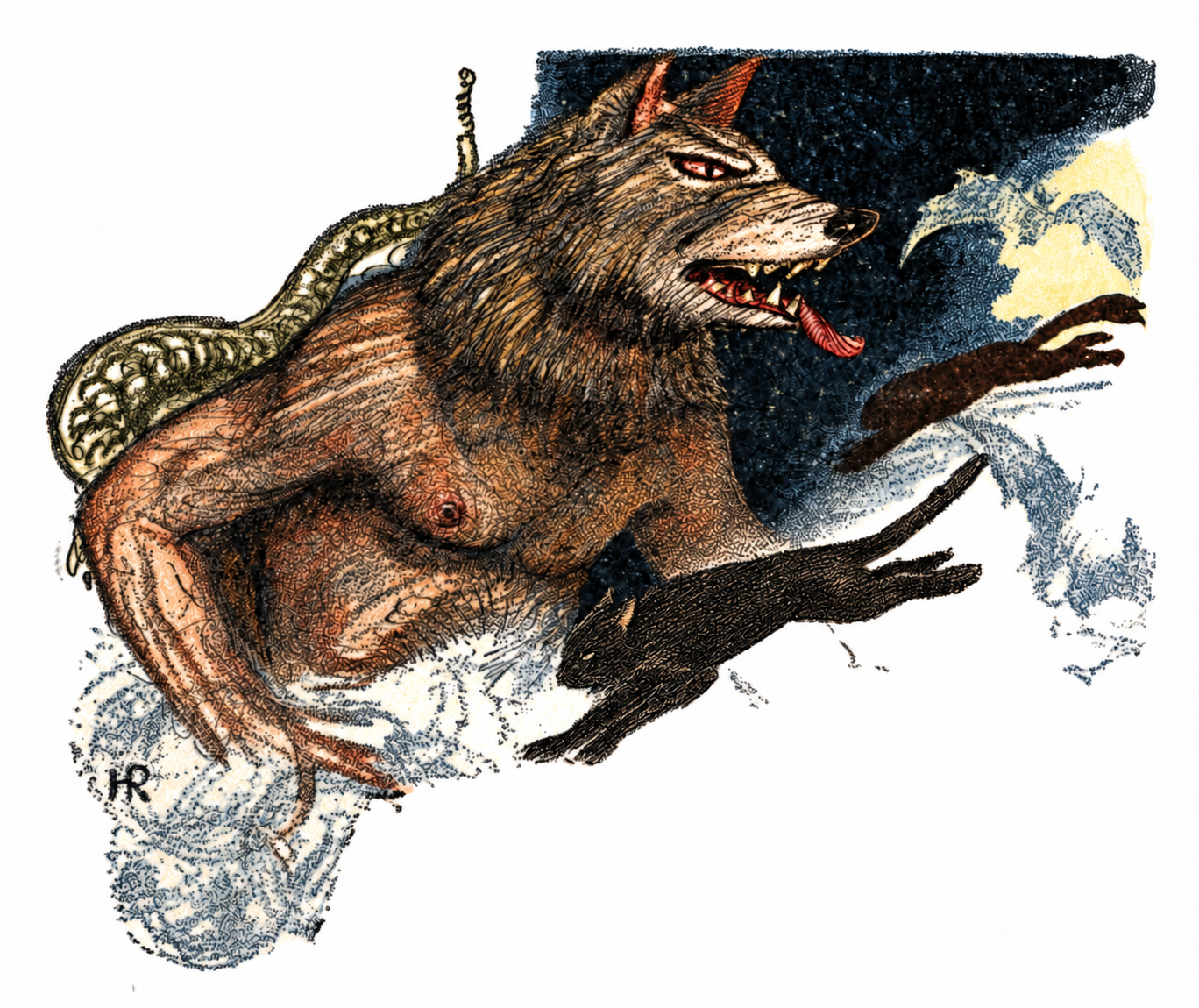
The Main Street Ghost, whether the editorial staff of the Arizona Daily Star realized it or not, bore a striking similarity to the Nagual (or Nahual) of Mesoamerican folk religion. The Nagual was believed to be a sorcerer or sorceress who possessed the power to shapeshift into their tonal, a lifelong animal counterpart spiritually connected to the person and determined by their birth date. Naguals could use this power for good or evil, and the practice was generally accompanied by hallucinogens such as peyote. The accounts of the Main Street Ghost sound like a slightly garbled description of the Nagual.
Deriving from pre-Columbian shamanistic traditions, Spanish missionaries recorded Nagualism beliefs, decrying them as unholy and seeking to suppress these occult practices. According to a 1530 report from Honduras, "The Devil was accustomed to deceive these natives by appearing to them in the form of a lion, tiger, coyote, lizard, snake, bird, or other animal. To these appearances they apply the term Naguales, which is as to say, guardians or companions; and when such an animal dies, so does the Indian to whom it is assigned." While individual Naguals weren't always viewed as having ill intent, clergy reports from this era reflect fear of the tradition.
Franciscan Friar Bernardino de Sahagun wrote in his 16th century "La Historia General de las Cosas de Nueva España" that, "The naualli, or magician, is he who frightens men and sucks the blood of children during the night. He is well skilled in the practice of this trade, he knows all the arts of sorcery (nauallotl) and employs them with cunning and ability; but for the benefit of men only, not for their injury. Those who have recourse to such arts for evil intents injure the bodies of their victims, cause them to lose their reason and smother them. These are wicked men and necromancers." In addition to animals such as jaguars, dogs, weasels, owls and roosters, Naguals were thought to have the power to alter the weather to protect crops and make inanimate objects appear like animals, such as a stick seeming to be a snake or a stone a scorpion.
An ethnographic study on Nagualism—published in 1894, the same year as the Main Street Ghost saga—described the powers attributed to the Nagual by then-present day lower class Mexicans: "The nahual is generally an old Indian with red eyes, who knows how to turn himself into a dog, woolly, black and ugly. The female witch can convert herself into a ball of fire; she has the power of flight, and at night will enter the windows and suck the blood of little children."
The Black Phantom Dog
Another possible influence lies across the Atlantic. The Main Street Ghost also bears a resemblance to the prevalent British legend of the Black Phantom Dog, a massive spectral canine—sometimes the Devil in disguise—with glowing black eyes, encountered at night in lonely places. These stories accompanied Europeans who settled in the U.S., with reports of Black Dogs appearing in the New World. Stephen Crane, author of "The Red Badge of Courage," collected such a legend in an 1894 newspaper article about ghosts of the New Jersey coast. "The Tale of the Black Dog" pre-dated the Revolutionary War and was likely sourced by Crane from oral tradition. It told of a loyal canine who survived a shipwreck near Barnegat Bay and dragged its master's lifeless body to shore, only to be killed while faithfully defending the corpse from looting pirates. "The phantom of this black hound is what the fisherman see as they return home from their boats and nets late at night," wrote Crane. "There is a dreadful hatchet wound in the animal's head, and from it the phantom blood bubbles. His jaws drip angry foam and his eyes are lit with crimson fire. He gallops continually with his nose to the ground as if he were trailing some one. If you are ever down upon the New Jersey coast at midnight and meet this specter, you had better run."
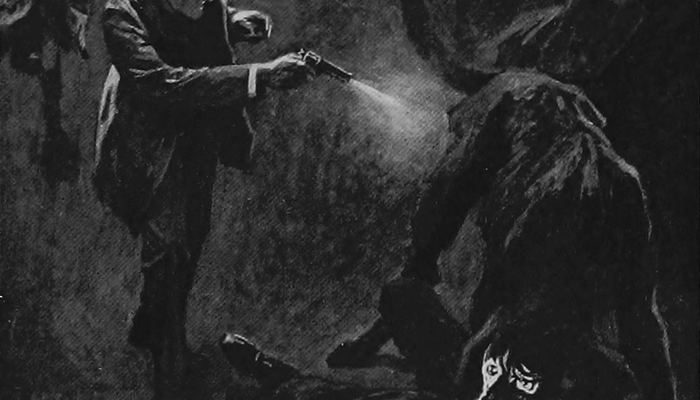
The dread-inspiring Phantom Black Dog motif may not have influenced Tucson's Mexican residents during the Main Street Ghost affair, but it certainly could have resided in the recesses of any Anglo reporter's brain while covering the local ghost dog story.
The Newspaper Investigates
At this point, the Arizona Daily Star claimed that its staff had begun staking out south Main Street during the wee hours, although the investigation was often depicted in satirical fashion. A Sep. 26 article, presented as a comical dream, joked, "The snake editor, Mr. R. G. Bradfield, was in the lead, armed with the office shot gun; the plate editor, Mr. Ignatius Riesgo, followed with 'the greatest story of the day,' which made six columns, and was heavy enough to brain a grizzly with; then followed the scoop (?) editor, Mr. Robert A. Todd, a pair of rusty shears, 12 3/4 inches long, in his fist. Next came the society editor, Mr. Earle F. Calvert, with a borrowed No. 14 patent leather in his left hand, and the 'Blue Book' of Tucson's four hundred under his arm; and last were the crank editor and sporting man, each groaning under the weight of a half dozen side sticks. The little army of brave men paraded about the haunted locality for a few seconds, when all came to an abrupt halt, for rising as if out of the ground, scarcely ten feet ahead, was a something." The something was a devilish canine with searchlight eyes. When the scoop reporter asked the creature's identity, it replied, "I am the chief of the park commission in Hades, Sir," and ultimately vanished with a thundering sound and the whiff of brimstone.
The Daily Star claimed to have identified the actual ghost on Sep. 28, although it's hard to know if this was true or yet another creative writing exercise, albeit grounded further in reality. The paper boasted that its "STAR Force" had arrived on Main Street at 1:30 a.m. the morning of Sep. 28 , where the "great electric lights in the south end of town shone unusually bright, and caused the big leafy-topped trees in the haunted locality to cast great shadows." Soon after, the deep quiet was interrupted by the clanking of chains. "The sound came from the shadow cast by a mulberry tree, and as the newspaper people approached the spot a big four-legged black object darted toward them. Without hesitating a moment, the 'profession' seized the something and a second later the bright light from the crank editor's bull's eye fell full upon a—dog, a big, fine black fellow. Attached to the big collar about his neck was a long chain. The poor brute acted as if it was nearly scared to death. And this is the ghost," wrote the paper. "It is quite likely that someone took the canine when it was young and tied it in a back yard. There it grew into doghood, and when about a week ago the peg to which the chain was fastened (the dog at the other end) loosened, the dog secured his freedom. It was a new life to it and consequently it acted as any scared dog would act."
"This is probably the last chapter to the Main-street mystery," boasted the Arizona Daily Star. SPOILER: It wasn't.
The Ghost Is Laid — And Unmasked
The Arizona Daily Citizen announced on Oct. 22 that, "The Main Street spook has been laid." Had Officer Roche managed to hit it with his bullets the month before, the paper teased, he would have found "only a very villainous piece of flesh and blood."
"The ghost wore a cap—a fantastic affair made from the corner of a pillow case. In it were cut holes at the mouth, and eyes covered with coarse veiling. To the superstitious it would be a very terrible spook indeed," wrote the Daily Citizen. "And now the ghost has been laid, as and in a very prosaic fashion. It is nothing only a common thief. It was a ghost for commercia! purposes only."
The ghost in question was Juan A. Llames Tenorio, an "undesirable citizen" who arrived in Tucson from Yuma the previous May, after serving a term in the territorial penitentiary. Since that time, numerous houses throughout the city had been robbed. Officers led by Marshal Bob Paul had ever since been on the keenest lookout for the perpetrator. A trunk stolen from the home of a Mr. Knox in September was only one of a long series of thefts. Also taken from various other residences were two other trunks, a fancy shaving set, a harness, umbrellas, dishes, pictures, cots, feather beds, clothing, and a dictionary. There was really no limit to what the burglar would steal. The railroad was also robbed, with 38 pairs of shoes stolen and groceries, from a sealed car, missing. The purloined goods were located in three different houses.
Paul arrested Tenorio (also referred to in the press as Juan "Antonio" Llanos), alleged to be the ringleader, along with Lauro Garcia, Louis Provencio, and some unnamed women on several charges. They were accused of being the parties that were terrorizing people in the south end of Tucson by appearing on the streets late at night "in unconventional attire and making the superstitious ones believe that they were from another world," wrote the Daily Star. "It seems that these parties, assisted by several other hard characters, have been playing the ghost dodge to better their chances for committing theft. Marshal Paul had been working on the case for some time, and when he made arrests he got possession of all their paraphernalia."
The authors of the Main Street Ghost scare appeared before Justice Culver on Oct. 23 and 24, the courtroom and sidewalk crowded with residents who were anxious to learn the outcome. "The capture of the South Main street ghost has eased the minds of the superstitious ones down that way not a little," mused the Daily Star the following day.
On March 14, 1895, Tenorio appeared before a jury and was convicted of grand larceny. A separate charge of burglary was dismissed. "Tenorio is the fellow who some weeks ago caused no end of excitement among the residents of South Main St., by playing the part of a ghost," wrote the Daily Star. "He worked his game in a professional sort of a way and the people in the neighborhood in which he operated were so badly scared that some of them moved to another part of the city. Tenorio wore a hideous mask and prowled about South Main Street at unseemly hours of the night, chasing any one whom he saw. Parties were formed to capture the ghost and while they were out searching, Tenorio managed to get into their houses and help himself to things." Tenorio, "the late spook of Barrio Libre" (per the Citizen) was sentenced to eight years in Yuma penitentiary by Judge Bethune for his innumerable small thefts while masquerading as the Main Street Ghost. "He is a hard citizen, ready to do anything to get money," reflected the Daily Star.
Something Older Than Tucson?
The Arizona Daily Star conveniently seemed to forget that it had already "solved" the case by pinning the fiasco on a stray dog. However, the official explanation doesn't totally gel. In a rather genius criminal plot, Tenorio and his compatriots turned the fear and superstition regarding the Main Street Ghost into opportunity. As Tenorio ran around the Barrio Libre border in costume and chased pedestrians, curious parties emerged to ghost hunt, leaving their homes (possibly on the wealthier side of town) unattended and prey to burglary. But did Tenorio initiate the whole affair? His crimes began around May and the Main Street Ghost stories hit the press in September, so it's possible. Descriptions of the phantom, though, described an animal with flaming eyes who could vanish into thin air. Does that sound anything like a criminal wearing a pillow case?
Perhaps Tenorio's gang exploited a fear that already existed. Perhaps a stray dog, a frightened neighborhood, and an old belief in Nagual witches combined to create a legend larger than any one event. Or perhaps, as some residents of Barrio Libre believed in the autumn of 1894, something far older than Tucson itself briefly wandered the streets near Carrillo's Gardens.
Sources
- "It Has Four Legs." Arizona Daily Star [Tucson, AZ], 23 Sep. 1894, p 4.
- "The City in Brief." Arizona Daily Star [Tucson, AZ], 25 Sep. 1894, p. 4.
- "It's Still in the Ring." Arizona Daily Star [Tucson, AZ], 26 Sep. 1894, p. 4.
- "Tohono Oʼodham." Wikipedia, https://en.wikipedia.org/wiki/Tohono_O%CA%BCodham. Accessed 26 Jul. 2026.
- "One Extremely Obscure Cryptid From Every U.S. State." YouTube, uploaded by Dime Store Adventures, 10 Jul. 2026.
- "Los Tucsonenses: The Mexican Community in Tucson, 1854–1941." BiblioVault.
- "Tucson, Arizona." Wikipedia, https://en.wikipedia.org/wiki/Tucson,_Arizona. Accessed 25 Jul. 2026.
- Otero, Lydia R. La Calle: Spatial Conflicts and Urban Renewal in a Southwest City. University of Arizona Press, 2010.
- Bell, Dennis R., et al. Barrio Historico Tucson. College of Architecture, University of Arizona, 1972.
- Sheridan, Thomas E. Los Tucsonenses. University of Arizona Press, 1986.
- "The City in Brief." Arizona Daily Star [Tucson, AZ], 25 Sep. 1894, p. 4.
- "Local News." Arizona Weekly Citizen [Tucson, AZ], 29 Sep. 1894, p. 4.
- Brinton, Daniel G. Nagualism. Philadelphia, MacCalla & Company, Printers, 1894.
- "Nagual." Wikipedia, https://en.wikipedia.org/wiki/Nagual. Accessed 24 Jul. 2026.
- "Tonal (Mythology)." Wikipedia, https://en.wikipedia.org/wiki/Tonal_(mythology). Accessed 24 Jul. 2026.
- "Florentine Codex." Wikipedia, https://en.wikipedia.org/wiki/Florentine_Codex. Accessed 25 Jul. 2026.
- Simpson, Charles A., and Jacqueline, and Steve Roud, editors. A Dictionary of English Folklore. Oxford University Press, 2003.
- "By the Way." South Wales Argus [Newport, Gwent, Wales], 15 Dec. 1908, p. 3.
- Comstock, Sarah. "Seeking History Nearby: This Story Takes You by Ferry and by Trolley to Staten Island Revolutionary Ground, Where a Quaint Old Homestead Stands." New York Times, 25 Jun. 1916, sec. 2, p. 9.
- "First Washington Shaft Now a Neglected Ruin." Buffalo Courier [Buffalo, NY], 17 Feb. 1924, p. 88.
- Hoffman, Daniel. "Stephen Crane's New Jersey Ghosts: Two Newly-Recovered Sketches." Proceedings of the New Jersey Historical Society, vol. 71, no. 4, Oct. 1953.
- "It's Still in the Ring." Arizona Daily Star [Tucson, AZ], 26 Sep. 1894, p. 4.
- "The Mystery Yet Unsolved." Arizona Daily Star [Tucson, AZ], 27 Sep. 1894, p. 4.
- "The Mystery at Last Solved." Arizona Daily Star [Tucson, AZ], 28 Sep. 1894, p. 4.
- "All About the Main Street Spook." Arizona Daily Citizen [Tucson, AZ], 29 Sep. 1894, p. 4.
- "The Spook Is Laid." Arizona Daily Citizen [Tucson, AZ], 22 Oct. 1894, p. 4.
- "The City in Brief." Arizona Daily Star [Tucson, AZ], 22 Oct. 1894, p. 4.
- "The City in Brief." Arizona Daily Star [Tucson, AZ], 24 Oct. 1894, p. 4.
- "The City in Brief." Arizona Daily Star [Tucson, AZ], 25 Oct. 1894, p. 4.
- "In the District Court." Arizona Daily Star [Tucson, AZ], 15 Mar. 1895, p. 4.
- "In the District Court." Arizona Daily Star [Tucson, AZ], 16 Mar. 1895, p. 4.
- "Local News." Arizona Weekly Citizen [Tucson, AZ], 23 Mar. 1895, p. 4.
Written by
Kevin J. Guhl
Journalist and researcher investigating forgotten American history, cryptids, folklore, and the paranormal. Author of American Strangeness.